
Networking for Success!
Share my stuff with a person you know you know knows someone that may know someone they know may know Elon Musk! (That wasn't a typo. English is fun!)

I like programming and learning about stuff I find interesting. Particularly interested in functional programming and typing systems.
I have a background in Cognitive Science/Psychology and Mathematics. Sadly halted due to physical and mental health issues arising from getting Covid. Which unfortunately hit me quite hard back on 2020. I'm still dealing with some sequels so I would prefer working from home.
I find it fun trying to find insights that cut across disciplines. I tend to favor the "theoretical" side of things. But I also try to get as much hands-on experience as possible.
I am writing a blog. Trying to share what I learn, and that others might find useful. I try to focus on the unique things I can bring to the table. Hoping to add value to the life of other developers. I always have a thousand ideas racing through my mind, so I don't have any trouble coming up with ideas on what to write. If any, I have a hard time cutting down on the number of things I want to write about :D
On a personal note. I have always been quite solitary and introverted. But I don't think I'm shy. I love videogames and started programming because I wanted to make my own.
So I decided to work a little bit on my online presence. I'll share with you what I did. Hoping you find It useful if you want to do the same.
But by now you know me... Im a sucker for those sweet theoretical ramblings. Im just not satisfied with the what. Give me the why!
So I'll also share the theoretical underpinnings of why I am doing this and the way I am doing it. I will make it worth your time. I promise!
Setting up LinkedIn
I started with my LinkedIn profile at the suggestion of my pal Miki Szeles! I updated my profile picture and the About section to match what I have here in Hashnode. You can see it below this post. Im also sharing my new blog post there.
Please check my LinkedIn profile.
Other than that I have to say that I found LinkedIn very hard to use and distracting :(
Making my GitHub profile Legendary
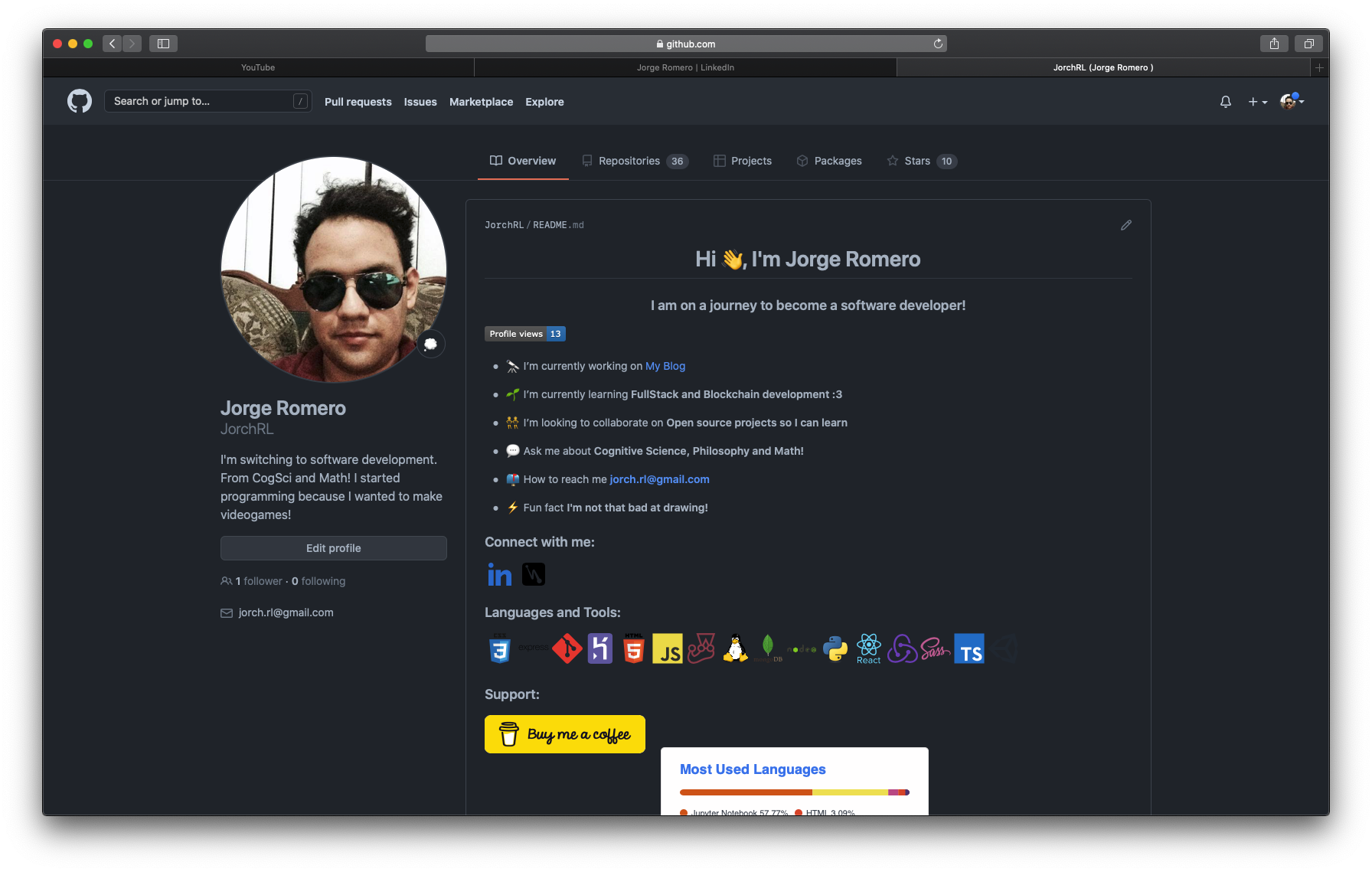
Miki also shared a tutorial by naveenkumar j on how to setup your GitHub readme.md that appears on your profile page.
Check my GitHub profile. It looks like this:
Buy me a coffee?
I added a link to my Buy Me a Coffee page, so you can now buy me a coffee if you want!
You still here? Good. Let's get to the whys !
Small networks
In the 1950's psychologist Stanley Milgram performed a fascinating experiment, now famously called the small world experiment. He calculated the average path length between any two persons on the United States.
He and his peers found that, surprisingly, there is an average of 6 persons of "distance" between any two persons. On the whole country!
Perhaps you know this concept as the "six degrees of separation" idea, originally conceived by Hungarian author Frigyes Karinthy.
It seems that social network relationships are neither random nor completely disorganized. Rather, societal relationships tend to form networks with certain mathematical properties. One of them, the small world property characterizes precisely this phenomena.
On the paper "Collective Dynamics of 'small world' networks" Duncan and Strogatz (1998) start by challenging the idea that networks are either completely regular or completely random.
And propose a mathematical model for networks somewhere in the "middle ground". Regular (non random) networks in which we introduce increasing amount of disorder. But not so much as to turn them completely random.
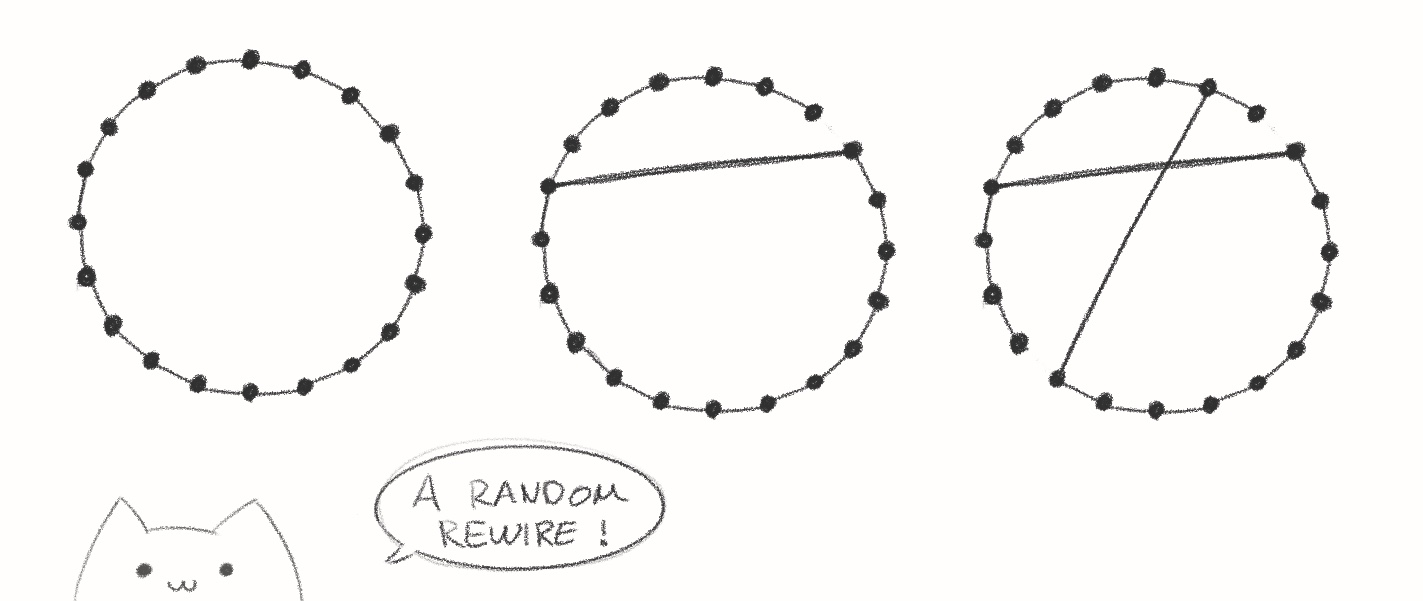 At some point, when the network is no longer regular, but still not completely random, some interesting properties just pop into existence. They are highly clustered, yet have very short path lengths. They call these networks "small world" networks.
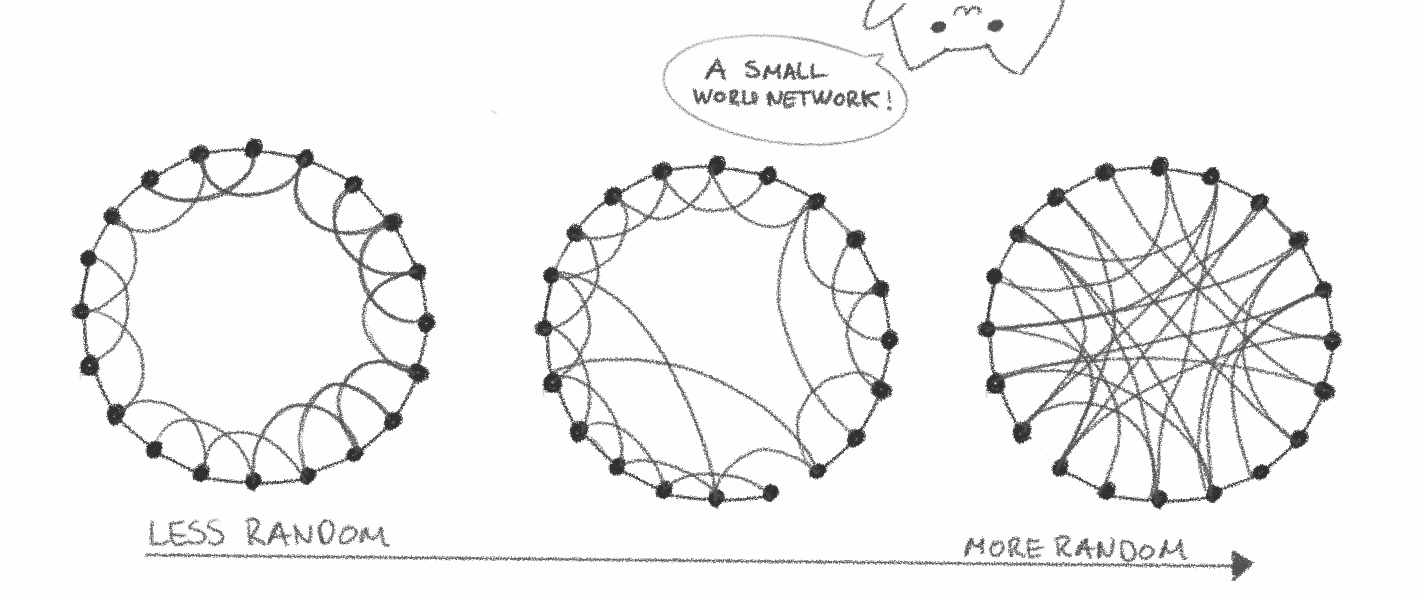
Regular networks have large average path lengths. And random networks have very short average path length, but are not highly clustered. Small-world networks are both highly clustered and have short average path lengths. So it is something special when these properties converge.
Network thinking
Here's the beautiful, and somewhat spooky, thing. It turns out that these kinds of networks are EVERYWHERE. In physic, chemistry, biology and neuroscience. Network topologies, social graphs, regulatory genetic networks, ecological networks. There's something going on here.
Network thinking in plain terms means switching how you think. From thinking of things that happen in the world in terms of individual entities, into thinking about how the connections and relations between entities give place to these phenomena.
How would you network-think about success?
It’s a small world anyways
Enough theory. Let's see what science has to say about this, applied to networking in an industry!
Hopefully I can get you to network-think about, well, Networking!
People usually think "the more the better" when it comes to networking. I mean, it makes common sense, right? But scientific findings by Rob Cross from the University of Virginia show that the 20% top-performers across various industries tend to have smaller networks, not bigger ones.
Whats more, findings suggest that having enormous networks may actually be detrimental.
In fact, there is a negative statistically significant likelihood of being a top performer and knowing a lot of people. Please read that again. And now another time.
I would speculate that by building enormous networks, you increase the randomness of your network. And make it less prone to exhibit those juicy small world characteristics that mathematicians rave about!
So what the heck is going on?
Top performers DO network. They just do it differently. What makes them distinct is how they make connections. So what do they do?
They develop open networks. That is, build ties outside their specialty or field. They branch out from their area or industry.
They mantain balanced ties across organizational lines. Cross functional as well as hierarchical. They make a point of knowing CEOs as well as clerks. They make friends in accounting as well as in R+D. This allows them to learn things others might not.
They nurture relationships that extend their abilities. If you connect only with people that think like you or work on the same thing as you are very unlikely to develop new perspectives. Or gain deeper insights and knowledge.
They build high-quality connections. And their behavior is consistent with that. Creating a handful of meaningful connections is much much more powerful than having several hundred acquaintances.
In brief. The more open your network, the better. And the higher the quality of the few relationship you actually make, the better off you are.
Again, social science is HARD.
The obligatory book recommendations!
Rob Cross and Robert J. Thomas wrote a book on these findings.
Also, for the theoretically minded:
The study of networks belongs to the more broad interdisciplinary field of complexity. Which borrows from pretty much everything from math to sociology.
Complexity: A guided tour by Melanie Mitchell. If you are going to read just one book about complexity, read this one. It is aimed to a scientific audience, but it is not mathematically heavy at all.
Reinventing Discovery: the new era of networked science by Michael Nielsen. This book elaborates the idea of networked science and creativity. This book will completely shatter what you think creativity is. Given the context of a network of individuals working on a field.
Worlds Hidden in Plain Sight by David Krakauer (Ed). This is a collection of essays, produced by the Santa Fe Institute, from 1984 to 2019. It shows how the scientific thinking about complexity and networks has evolved over the years.
Ok that last one is perhaps a little bit too theoretical. But It has a couple very preconception-shattering essays.
Epilogue
As you may imagine, I write these post with lots of love. I get really encouraged when I get comments! So you can support my efforts by leaving a comment, it means a lot to me! Part of the reason I am writing this blog is to help me get through depression (a story for another time).
I'm also open to any feedback. While the topics that I showcase tend to be on the heavy theoretical side, I write with the express goal of making them simple to understand and useful for you. If am not achieving my goal I really would like to know!
I wonder If it would be ok to make the Amazon links affiliate links. Would you be ok with that?
See you tomorrow!



